
Radiation safety guidance: what to know

What to do after your BEXLUTRY treatment
After you receive BEXLUTRY, radiation remains in your body for a period of time and leaves your system mainly through urine. Following these safety steps helps protect you and the people around you.
It's understandable that not every recommendation may be practical for your household. Do the best you can based on your personal situation and consult your care team for any questions.
For the first 3 DAYS after your infusions

Hydration
- Drink plenty of liquids and urinate often to remove BEXLUTRY from the body

Bathroom use
- Sit down when using the toilet to avoid splashing
- Flush 2 times with lid closed after each use
- Clean any spills right away
- Wash hands well with soap and water
- For Caregivers: Wear disposable gloves when helping with bathroom needs or handling bodily fluids, and dispose of in a separate bag

Close contact with others
- Stay at least 3 feet away from other people and pets
- Do not use public transportation
- Wait 3 days before returning to work in person
For the first 7 DAYS after your infusions

Personal hygiene
- Take a shower every day to help remove radioactive skin contamination
- Wash clothing, towels, and bedding separately from other household members

Sleeping and personal space
- Sleep alone to limit radiation exposure to others, including children and pets
- Avoid sexual activity
- Limit close physical contact

Close contact with others
- In general, maintain 3-foot distance from children and pregnant people
- Avoid close contact in crowded public places
Additional safety measures around pregnancy

- Do not share a bed with a pregnant person for up to 15 days after your infusions

Safety for people of reproductive potential
- Use effective birth control during treatment and for 7 months after the final dose
- Do not breastfeed during treatment and for 2.5 months after the final infusion
- During this time, you may continue expressing breast milk to maintain lactation; milk should be discarded or stored until safe for use per your doctor's or care team's direction
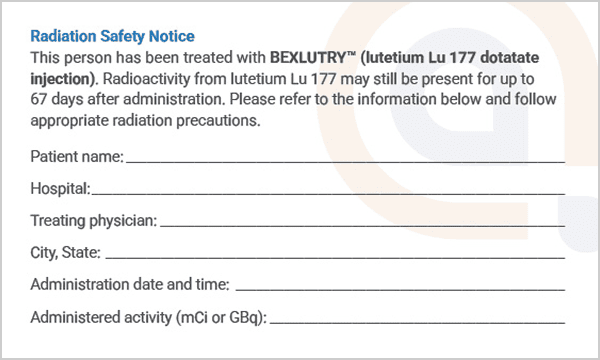
TREATMENT TRAVEL CARD
Carry your radiation treatment card when you travel after your BEXLUTRY treatment. Some airport and security screening machines may pick up leftover radiation from your BEXLUTRY treatment. This radiation treatment card explains why. Print the treatment card, have your care team fill it out, and carry it with you when you travel.

Your treatment center may provide different guidance based on your situation. If anything is unclear, your care team is there to help.

Your care doesn't stop after treatment
Learn about the support available to help you throughout your journey.

Learn about an imaging tool that can help diagnose GEP-NETs

Important Facts
What are some important things to know about the safety of Bexlutry?
Bexlutry may cause some serious side effects, and in some cases your healthcare provider may need to adjust or stop your treatment. You should always follow your healthcare provider’s instructions. These safety considerations include:
- Radiation Exposure: Bexlutry is a radioactive medicine that contributes to your long-term radiation exposure. This may increase your risk of developing cancer later in life. Radiation from Bexlutry can be detected in your urine for up to 30 days after each treatment. It is important to reduce radiation exposure to yourself, your caregivers, and others in your home during and after treatment. Your healthcare provider will give you specific instructions on steps you can take at home to reduce radiation exposure to people around you. Follow these instructions carefully.
- Bone Marrow problems: Treatment with Bexlutry may increase the risk of myelosuppression, a condition in which bone marrow activity is decreased and the number of blood cells in your body becomes low. This may lead to blood-related side effects such as low red blood cells (anemia), low platelets that help your blood clot (thrombocytopenia), and low white blood cells that help fight infection. Tell your healthcare provider if you develop signs or symptoms of infection, fever, chills, dizziness, shortness of breath, or unusual bleeding or bruising. Your healthcare provider will check your blood counts before and during treatment. Your treatment may be delayed, the dose may be reduced, or treatment may be stopped if your blood cell counts become too low.
- Secondary blood and bone marrow cancers: Treatment with Bexlutry may also increase the risk of developing certain blood and bone marrow cancers, including myelodysplastic syndrome (MDS) and acute leukemia. These conditions are uncommon but may occur months to years after treatment. Your healthcare provider will check your blood counts during treatment and may continue to monitor them after treatment.
- Kidney Problems: Treatment with Bexlutry exposes your kidneys to radiation and may impair their ability to work normally. You may be at increased risk for kidney problems if you already have kidney problems or conditions such as diabetes or high blood pressure before treatment. In some cases, patients have experienced kidney failure after treatment with Bexlutry. Your healthcare provider will give you an amino acid solution before, during, and after treatment to help protect your kidneys. You should stay well hydrated before, on the day of, and on the day after your treatment. You should also urinate frequently before, on the day of, and on the day after receiving Bexlutry. Your healthcare provider will monitor your kidney function and may delay, reduce, or stop your treatment if kidney problems occur.
- Liver Problems: Treatment with Bexlutry may cause liver problems. In rare cases, bleeding, swelling, or tissue damage in liver tumors have been reported. If you have tumors in your liver, you may be at increased risk for these side effects. Tell your healthcare provider right away if you develop signs or symptoms of liver problems, including yellowing of your skin or the whites of your eyes, unusual darkening of your urine, unusual tiredness, pain in the upper right side of your stomach area, confusion, and/or swelling of your stomach area. Your healthcare provider will monitor your liver function using blood tests and may delay, reduce, or stop your treatment if liver problems occur.
- Allergic Reactions: Treatment with Bexlutry may cause allergic reactions. In some cases, these reactions may be serious. Tell your healthcare provider right away if you develop symptoms of an allergic reaction. Seek emergency medical help right away if you experience symptoms of a serious allergic reaction. Symptoms may include swelling of the face, lips, tongue, or throat, trouble breathing or swallowing, rash, itching, or hives. Your healthcare provider will monitor you during and after treatment and may stop your treatment if a serious allergic reaction occurs.
- Hormonal Gland Problems: During treatment with Bexlutry, you may experience symptoms related to hormones released from your cancer. These symptoms may include flushing, diarrhea, difficulty breathing, and low blood pressure, and may occur during or within 24 hours after your first treatment. Your healthcare provider will monitor you closely. Tell your healthcare provider if you experience any of these signs or symptoms.
- Pregnancy Warning: Bexlutry can harm your unborn baby. Tell your healthcare provider if you are pregnant or think you may be pregnant. Females who are able to become pregnant should use effective birth control during treatment and for 7 months after the last dose of Bexlutry. Males with female partners who are able to become pregnant should use effective birth control during treatment and for 4 months after the last dose.
- Breastfeeding Warning: You should not breastfeed during treatment with Bexlutry and for 2.5 months after your last dose.
- Fertility Problems: Treatment with Bexlutry may cause fertility problems in males and females. This is because radiation absorbed by the testes or ovaries during treatment may affect your ability to have children. These effects may be temporary or permanent. Talk to your healthcare provider if you have concerns about fertility.
What are the most common side effects of Bexlutry?
The most common and most serious side effects of Bexlutry include decreased blood cell counts, increased liver enzymes, vomiting, nausea, increased blood sugar levels, and low potassium levels.
Tell your healthcare provider if you develop any side effects that bother you or do not go away. These are not all the possible side effects of Bexlutry; For more information or to learn more, talk to your healthcare provider.
What other medicines may interact with Bexlutry?
Tell your healthcare provider about all the medicines you take, including prescription and over-the-counter medicines, vitamins, and herbal supplements. Tell your healthcare provider if you are taking steroid medicines (such as glucocorticoids), as high doses may affect how this medicine works.
You should stop taking long-acting somatostatin analogs at least 4 weeks before treatment with Bexlutry. Short-acting somatostatin analogs may be used up to 24 hours before treatment.
You are encouraged to report negative side effects of prescription drugs to the FDA. Visit www.fda.gov/medwatch, or call 1-800-FDA-1088.
Please see full Prescribing Information for Bexlutry.
Approved Use
What is Bexlutry?
BexlutryTM (lutetium Lu 177 dotatate injection) is a prescription medicine used to treat adults with a type of cancer called gastroenteropancreatic neuroendocrine tumors (GEP-NETs), including neuroendocrine tumors of the foregut, midgut, and hindgut. It is used when these tumors have a protein on their surface called a somatostatin receptor, which allows the medicine to find and target them.